
Compact Worm Speed Reducer for Screw Feeders — Precise Low-Speed Material Dosing
Screw feeders extract granular or powdered mineral materials from hoppers and silos at precisely controlled volumetric rates. The drive system must deliver consistent low-speed torque with smooth, pulse-free rotation — any speed variation translates directly into dosing inaccuracy and downstream process problems. The compact worm gear unit is the preferred drive solution for screw feeders: its smooth output, compact right-angle form factor, and ability to fit beneath low-clearance hopper outlets make it ideal for this demanding application.
Application Demands and Worm Drive Solutions
- Low Output Speed (1–30 RPM): High reduction ratios up to 100:1 in single stage enable ultra-low screw speed from standard 4-pole motors.
- Constant Torque at Variable Speed: Variable-frequency drive compatible for mass-flow rate adjustment without gearbox changes.
- Compact Envelope: Right-angle output enables motor to mount horizontally alongside narrow hopper outlets where vertical space is limited.
- Minimal Backlash: Worm gear contact pattern produces smooth, backlash-free rotation essential for accurate gravimetric dosing systems.
- Thermal Stability: Grey iron housing with cooling fins dissipates heat from continuous low-speed duty without forced ventilation.
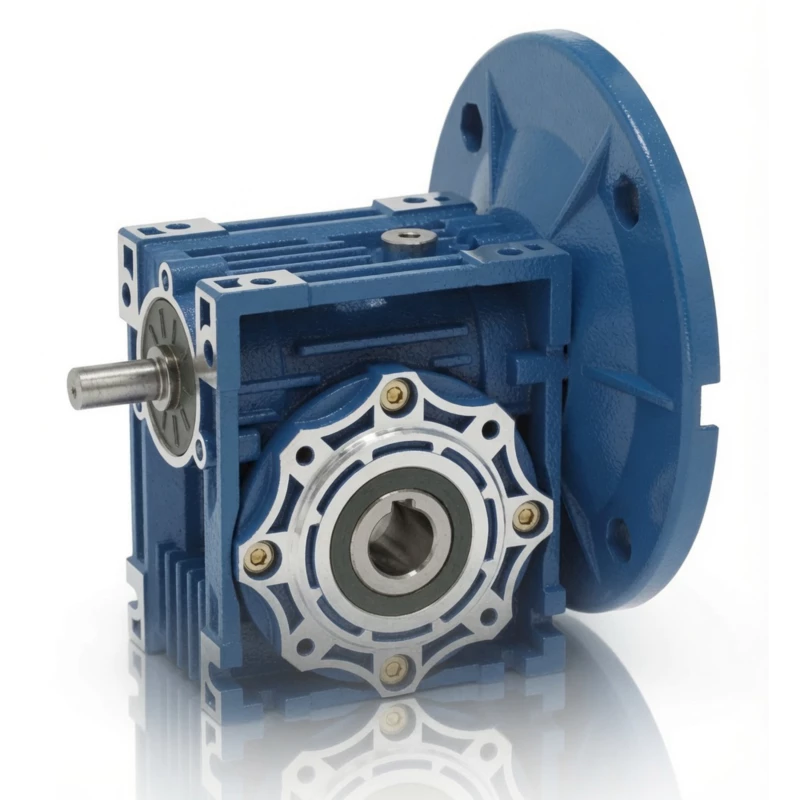
Screw Feeder Worm Reducer Selection Guide
| Selection Parameter | Recommendation | Reason |
|---|---|---|
| Reduction Ratio | 40:1 to 100:1 | Achieve 10–50 RPM output from 1,450 RPM motor |
| Service Factor | SF 1.25–1.5 | Accounts for start-up torque with full hopper |
| Housing Material | Grey cast iron with fins | Passive cooling without fan for dusty environments |
| Worm Shaft | Carbon steel, surface hardened | Cost-effective for moderate torque screw feeders |
| Worm Wheel | Cast phosphor bronze | Low friction coefficient for energy-efficient dosing |
Case Studies — Screw Feeder Worm Drive in Mining
Industry: Cement raw material dosing. Pain Point: Variable torque demand as limestone powder bridged and then avalanche-fed caused motor overload trips with the existing direct-drive system.
Solution: Installed NMRV series worm speed reducer (ratio 80:1) with 1.5 service factor oversize. Bronze worm wheel absorbed torque spikes from powder avalanching.
Outcome: Motor overload trips reduced from 4 per week to zero. Dosing accuracy improved to within plus or minus 1.5% of set point. Production throughput increased by 8% due to elimination of stoppages.
Industry: Coal-fired power generation. Pain Point: Underground hopper outlet had only 320 mm clearance between the screw shaft centreline and the structural beam above, preventing installation of any standard inline gearbox-motor arrangement.
Solution: Compact right-angle worm gearbox (ratio 60:1, grey iron housing) with motor mounted horizontally beside the screw shaft. Total drive height reduced to 280 mm.
Outcome: Successfully installed within existing structural constraint. Has operated continuously for 19 months feeding the coal mill at rated capacity.
Technical Q&A — Screw Feeder Worm Reducers
Why does a worm reducer produce smoother output than a helical gearbox for dosing applications?
Can screw feeder worm reducers work with variable-frequency drives (VFDs)?
Why Choose Us for Screw Feeder Drives
Our team calculates starting torque, thermal rating, and service factor for your specific hopper and screw feeder configuration.
Non-standard output shaft diameters and keyway configurations to match existing screw coupling designs.
Online startup troubleshooting and oil fill guidance for remote site commissioning without factory support travel.
Explore our full worm speed reducer range or send your screw feeder specifications to our engineering team. More application examples are available on our applications page.