Description
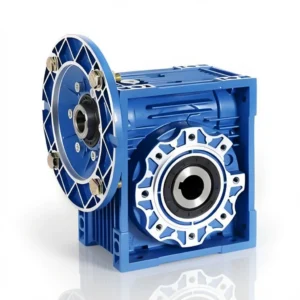
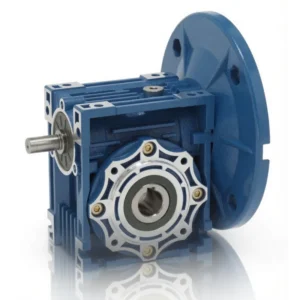
EP-NRV-E130 — Shaft-Input Aluminium Worm Gearbox with Tail Output Shaft
Technical Specifications — EP-NRV-E130
| Paramètre | Valeur |
|---|---|
| Série | NRV-E (Entrée à arbre plein, sans bride, arbre de sortie à vis sans fin) |
| Distance du centre | 130 mm |
| Taux de réduction | 5, 7.5, 10, 15, 20, 25, 30, 40, 50, 60, 80, 100 |
| Puissance d'entrée nominale | Up to 11 kW |
| Plage de vitesse de sortie | 14 à 280 tr/min (à une entrée de 1400 tr/min) |
| Couple de sortie maximal | 12,076 N·m |
| Configuration d'entrée | Arbre d'entrée plein (sans bride IEC) + arbre de sortie à vis sans fin |
| Arbre d'entrée | entrée d'arbre claveté massif |
| Arbre de sortie arrière | Sens de rotation de la vis sans fin (coaxial avec l'arbre de la vis sans fin, extrémité opposée) |
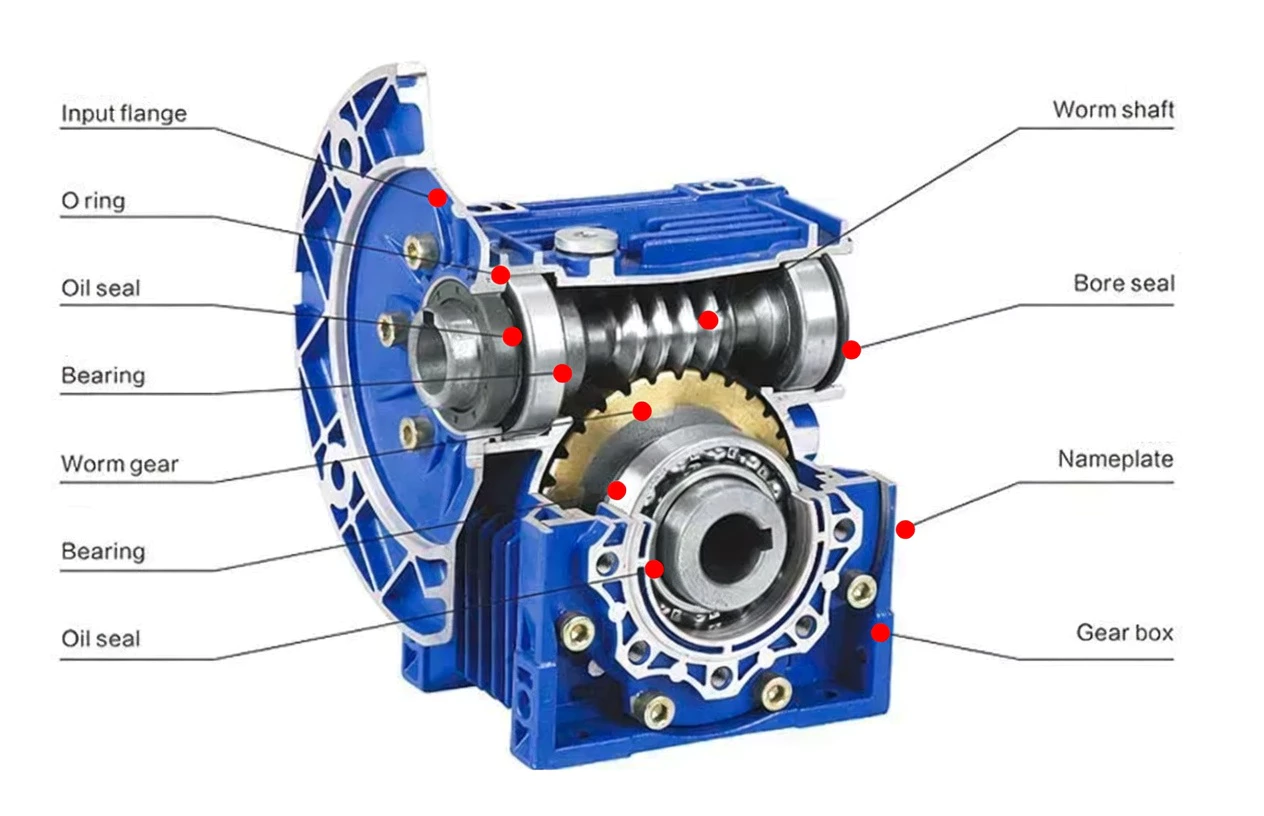
| Matériau du boîtier | Alliage d'aluminium moulé sous pression |
| Matériau de roue à vis sans fin | Bronze phosphoreux |
| Matériau de la tige de vis sans fin | Acier allié 20CrMnTi, cémenté, rectifié avec précision |
| Diamètre d'alésage de sortie | 45 mm H7 with keyway |
| Lubrification | Huile pour engrenages ISO VG 220 (remplissage d'usine) |
| Positions de montage | B3, B6, B7, B8, V5, V6 |
| Classe de protection | IP54 |
| Température ambiante | -10°C à +40°C |
NRV-E130 Performance Table (11 kW / 1400 r/min)
| Rapport (i) | Vitesse de sortie (tr/min) | Couple de sortie (N·m) | Facteur de service (fs) |
|---|---|---|---|
| 7.5 | 187 | 3,893 | 1.9 |
| 10 | 140 | 4,285 | 1.8 |
| 15 | 93 | 4,905 | 1.4 |
| 20 | 70 | 5,399 | 1.1 |
| 25 | 56 | 5,816 | 1.1 |
| 30 | 47 | 6,181 | 1.1 |
| 40 | 35 | 7,607 | 1.2 |
| 50 | 28 | 8,084 | 1.2 |
| 60 | 23 | 8,897 | 1.0 |
| 80 | 18 | 10,185 | 1.0 |
| 100 | 14 | 12,076 | 1.1 |
✅ Fonctionnalités principales et avantages uniques
🔗 Arbre de sortie à vis sans fin — L'élément clé de différenciation
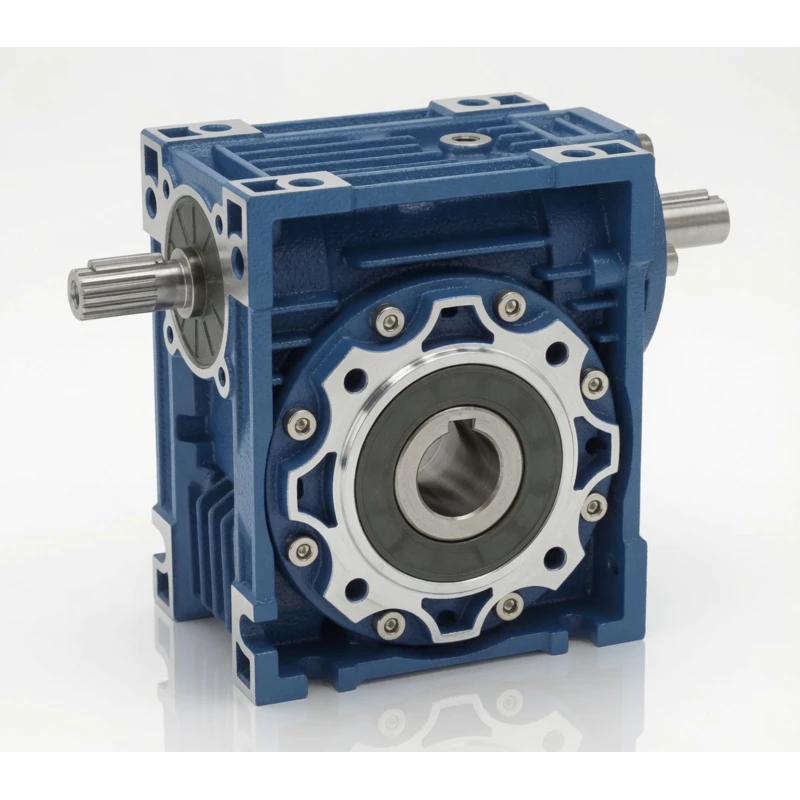
The defining feature of the NRV-E130 is its additional tail output shaft that extends in the same direction as the worm shaft axis. This second output enables simultaneous drive of two independent loads from a single gearbox — a primary application drive via the main output bore and a secondary auxiliary drive (encoder, tachometer, small pump, or fan) via the tail shaft.
📥 11 kW Chain + Port Throughput Monitoring
The NRV-E130 handles 11 kW chain input from diesel engines or hydraulic motor stations while the tail shaft provides the speed signal for port terminal management throughput monitoring systems.
◯ Same Torque as Standard NRV130
The NRV-E130 delivers identical maximum output torque (12,076 N·m) to the standard NRV130, confirming that the tail shaft adds zero performance penalty on the main output. The tail shaft is driven directly off the worm shaft end, not the output stage.
Encodeur et retour d'information prêts
L'arbre de sortie arrière fournit un point de connexion directe pour les codeurs rotatifs, les tachymètres et les générateurs d'impulsions qui surveillent la vitesse de l'arbre à vis sans fin dans les systèmes de contrôle de mouvement en boucle fermée, éliminant ainsi les supports de codeur externes et les éléments de couplage.
🚫 IP54 — Intégrité à double joint
L'alésage de sortie principal et la sortie de l'arbre de queue sont tous deux étanches grâce à des joints à lèvres à double contact, maintenant une protection IP54 dans toutes les orientations de montage sans suintement d'huile au niveau de l'interface de l'arbre.
🏭 Scénarios d'application
🚢 Heavy Crane Hoist Monitoring
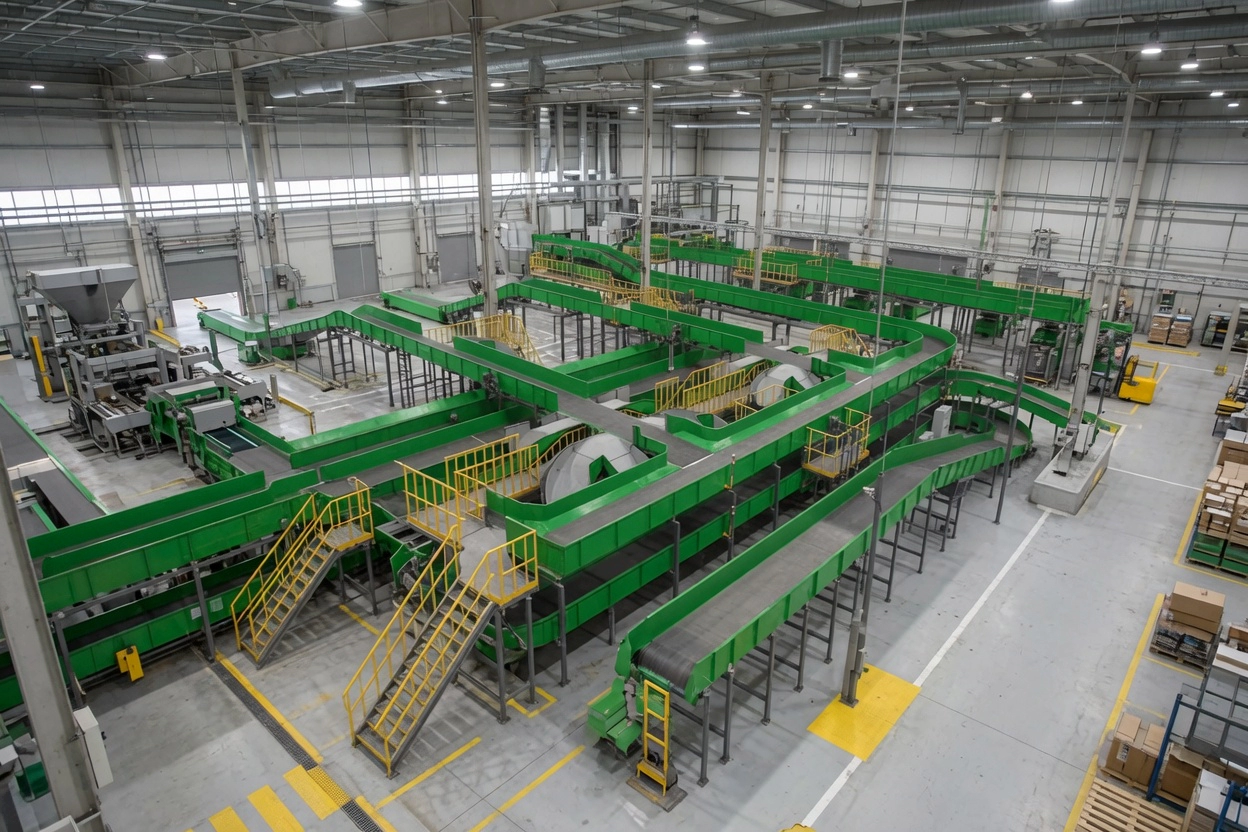
Extra-large NMRV-E130 worm gearbox for gantry crane hoist drum drives where the tail shaft provides real-time hoist speed feedback to the crane overload protection system.
📥 Port Bulk Handling SCADA
High-power worm gear reducer with tail output shaft for port grain conveyor drives where the tail shaft speed signal confirms throughput rate to the terminal management system.
🍲 Large Mining Instrumented Drive
Aluminium worm gearbox with tail shaft for large surface mining conveyor drives where the tail-mounted encoder feeds belt speed data to the mine belt management and splice monitoring system.
⚙ Large Reactor Process Control
NMRV-E130 worm gearbox for large chemical reactor agitator drives where the tail shaft encoder provides process speed feedback to the reactor control system for viscosity-controlled mixing.
🔎 Guide de sélection
Worked Example — Stacker-Reclaimer Position
Required: NRV-E130 at i=60, chain-driven from 11 kW diesel engine, tail shaft to terminal management encoder. Output speed = 23 r/min, torque = 8,897 N·m. Tail shaft: 500 PPR encoder, 45 mm bore. ✅ NRV-E130-60 selected.
⚖ NRV-E130 vs Standard NRV130
| Fonctionnalité | EP-NRV-E130 (with Tail Shaft) | EP-NRV130 (Standard) |
|---|---|---|
| Arbre de sortie arrière | ✅ Oui — sens du ver | Non |
| Montage de l'encodeur/de la rétroaction | Directement sur l'arbre de queue | Nécessite un support externe |
| Entraînement à double charge | Oui — principal + queue | Non — sortie unique |
| Couple de sortie principal | 12,076 N·m | 12,076 N·m |
| Dimensions du logement | Légèrement plus long (protubérance de la tige de queue) | Longueur standard |
| Entrée d'arbre | Oui — arbre claveté massif | Oui — arbre claveté massif |
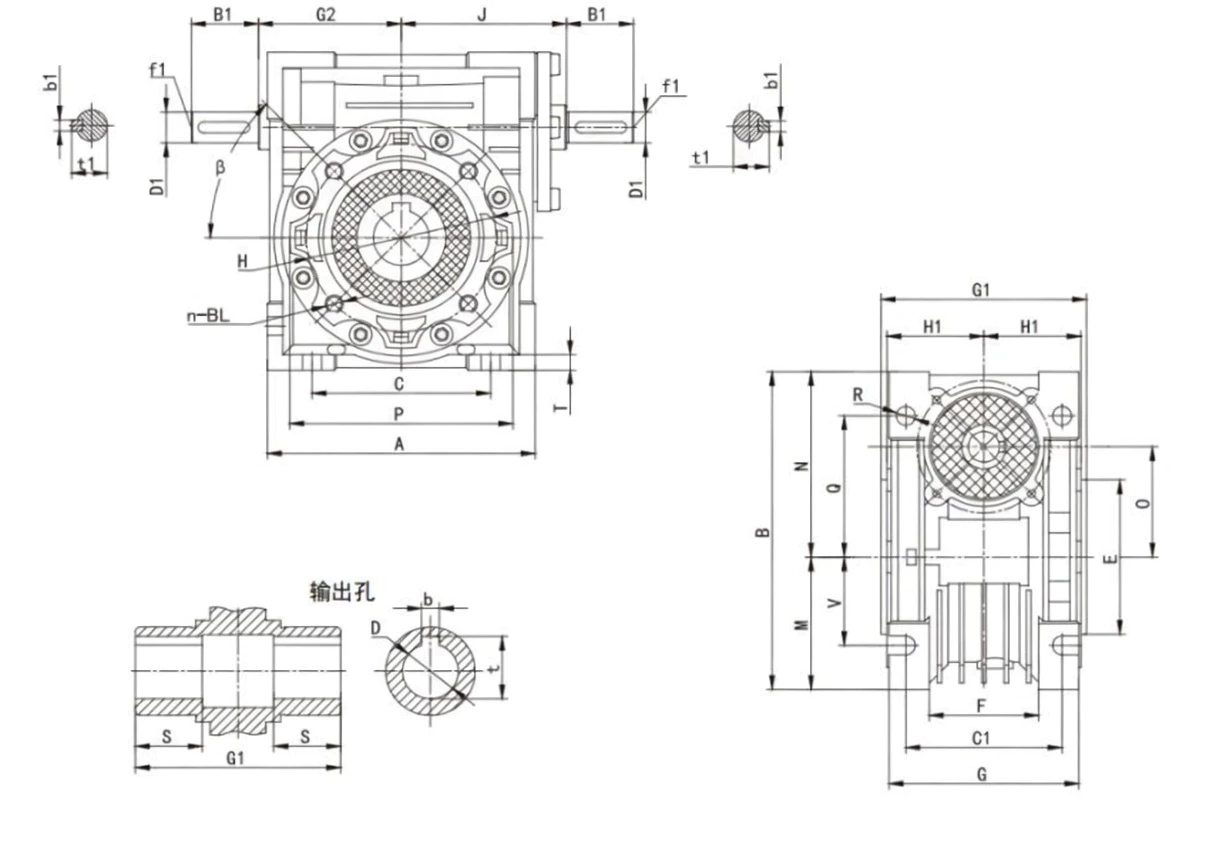
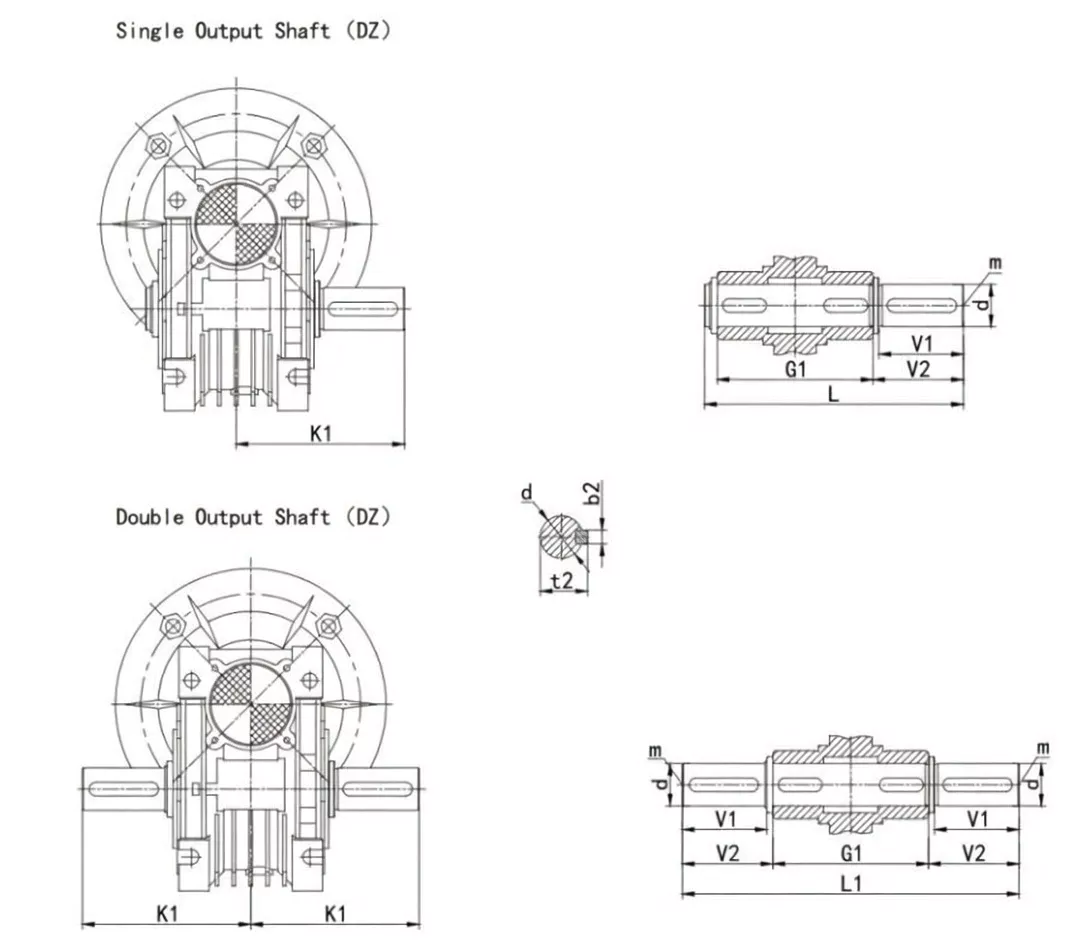
NRV-E130 Main Output Shaft Dimensions
| G1 (mm) | K1 (mm) | L/DZ (mm) | L1/SZ (mm) | b2 (mm) | d h6 (mm) | Keyway |
|---|---|---|---|---|---|---|
| 170 | 170 | 265 | 340 | 14 | 45 | M16 |
❓ Foire aux questions
What is the tail output shaft on the EP-NRV-E130 and how is it different from the main output?
The tail shaft on the NRV-E130 exits the housing in the worm-direction axis (opposite end of the worm shaft), while the main output bore is perpendicular (90 degrees) to the worm axis. The tail shaft is driven off the worm shaft end and is used for encoder mounting, tachometer connection, or light auxiliary drive, while the main output delivers the full 12,076 N·m load torque.
Does the tail shaft reduce the main output torque of the NRV-E130?
No. The tail shaft draws only the small torque needed for its connected device. The main output retains the full 12,076 N·m rating, identical to the standard NRV130.
What is the input shaft specification for the NRV-E130?
The NRV-E130 has a solid keyed input shaft (no IEC flange). The shaft diameter matches the equivalent NMRV130 bore input diameter. It accepts chain sprockets, belt pulleys, and rigid couplings. A bilateral (double-ended) input shaft is standard; single-end configuration available on request.
What encoder types can be mounted on the NRV-E130 tail shaft?
Any standard keyed rotary encoder with the matching bore diameter can be mounted on the NRV-E130 tail shaft: incremental (5V–24V, 100–10,000 PPR), SSI absolute, or resolver-type. Confirm the encoder bore size and keyway before ordering. The tail shaft key dimensions match the catalogue DZ shaft specification for NMRV-E130.
Can the NRV-E130 be used for closed-loop speed control in a chain-driven system?
Yes. The NRV-E130 is the ideal solution for chain-driven systems requiring closed-loop speed feedback. The chain drives the solid input shaft; the main output drives the load; and the tail shaft mounts an encoder that feeds speed/position data back to the controller. This eliminates the need for a separate encoder mounting bracket or a second independent encoder drive arrangement.
⭐ Avis clients
★★★★★
“Our heavy gantry crane long-travel chain drives use NRV-E130 units with tail-shaft encoders. Load positioning resolution improved to plus/minus 5 mm and our crane operators report significantly greater confidence in precision load placement.”
Craig S. — Crane Engineer, Heavy Industry 🇦🇺 Australia (SA)
★★★★★
“The NRV-E130 chain-drives our port stacker-reclaimer slewing mechanism and the tail-shaft encoder provides position data to our terminal management system. Installation was straightforward and the encoder interface was plug-and-play with our existing control hardware.”
Marco P. — Terminal Engineer, Bulk Port 🇳🇿 New Zealand
★★★★☆
“We use NRV-E130 on our large mining conveyor chain drive. The tail-shaft rotation sensor provides belt-speed data to our conveyor belt management system. Single-stage worm reduction replaced a two-stage arrangement and simplified maintenance significantly.”
Chris A. — Maintenance Superintendent, Gold Mine 🇦🇺 Australia (WA)
⚙ Accessoires et produits compatibles
⚡ Moteurs IEC (B5/B14)
Moteurs à courant alternatif standard avec bride IEC correspondante. Versions pour variateur de fréquence disponibles pour la régulation de vitesse.
🔗 Kits d'arbre de sortie
simple plein (DZ), double extrémité (SZ), bride de sortie (F), bride creuse (FL) — tous à tolérance H7/h6 avec rainures de clavette standard.
🔨 Bras de couple et supports
Bras de réaction de couple en acier pour les configurations de montage sur arbre ; plaques de montage de pied pour les orientations B3/B6.
🔒 Kits de joints et de reniflard
Kits de joints à lèvres de rechange, bouchons de ventilation et bouchons de vidange magnétiques pour des intervalles d'entretien prolongés.
Specify the EP-NRV-E130
Our team will confirm the input shaft, ratio, and encoder bore for your extra-large chain-driven instrumented industrial application.
Le EP-NRV-E130 aluminium worm gearbox combines a solid shaft input (no IEC flange) with an additional worm-direction tail output shaft. Centre distance 130 mm, ratios 5 to 100, input power up to 11 kW, max output torque 12,076 N·m. The tail shaft enables simultaneous encoder feedback, safety interlock monitoring, or auxiliary drive — the ideal instrumented shaft-input worm gearbox for chain-driven closed-loop agricultural, industrial, and mining drive systems.